Ventilation
Head tilt
Emma/Emily can be ventilated manually and mechanically under realistic conditions. Efficient manual ventilation can only be performed if the head is in the neutral position (sniffing position).
The current head position of the manikin is continuously monitored and displayed in real time on the user interface using the Head Position Sensor.
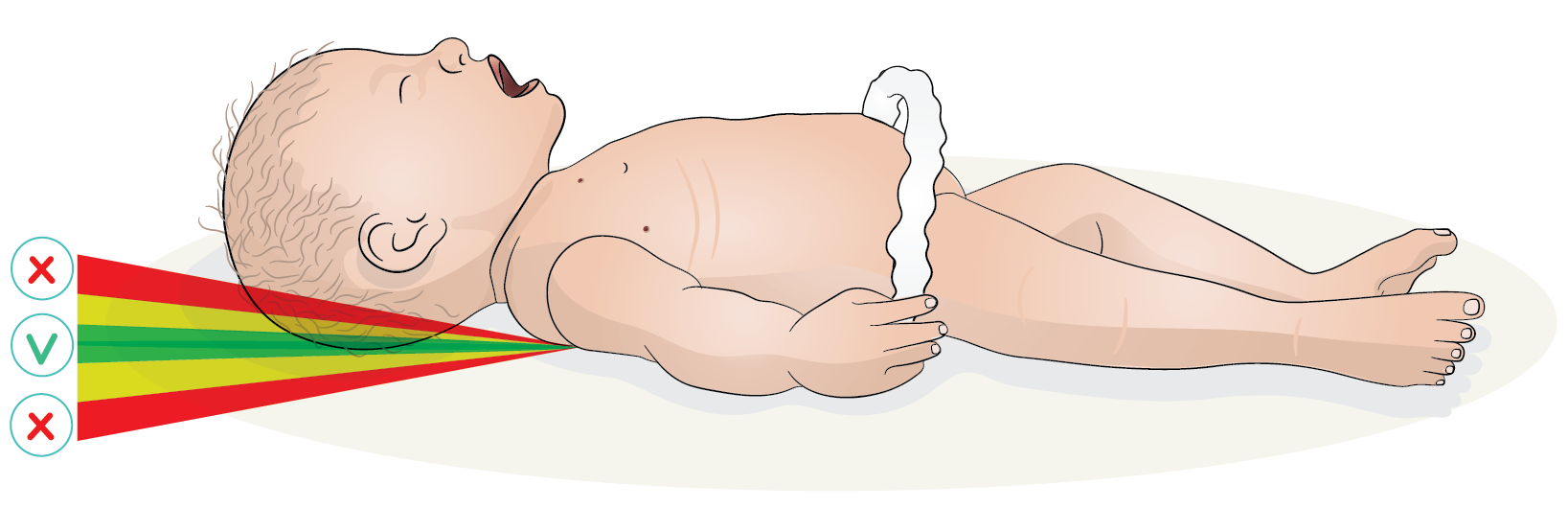
The correct head position is displayed on the user interface in real time.
|
|
| ||||
The head needs to be in neutral position for the chest to rise sufficiently during ventilation. | If the head is hyper-extended, the abdomen rises during ventilation. | If the head is bent too much, neither the chest nor the abdomen rise. |




NOTE
The green, yellow and red area can be changed by users. For more information, refer to the Pre-sets section.
Non-invasive ventilation
Manual ventilation, e.g. with a NeoPuff® system or bag, is recognized by the simulator and displayed on the GUI.
The ventilations are displayed at the current ventilatory rate in the Emma/Emily 3D simulation, the animated lung and, if an ECG is attached, also on the RR curve of the vital signs monitor.
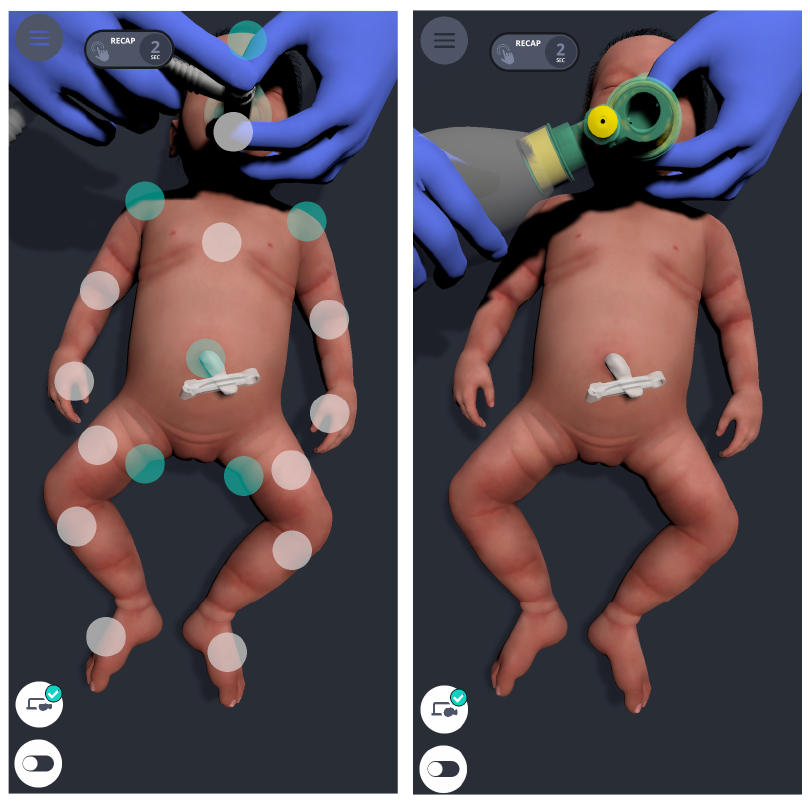
Ventilation can take place if spontaneous breathing is enabled but no longer sufficient. PEEP can also be administered via a ventilation mask. The effectiveness of the ventilation can be seen in a separate window that appears under ventilation.
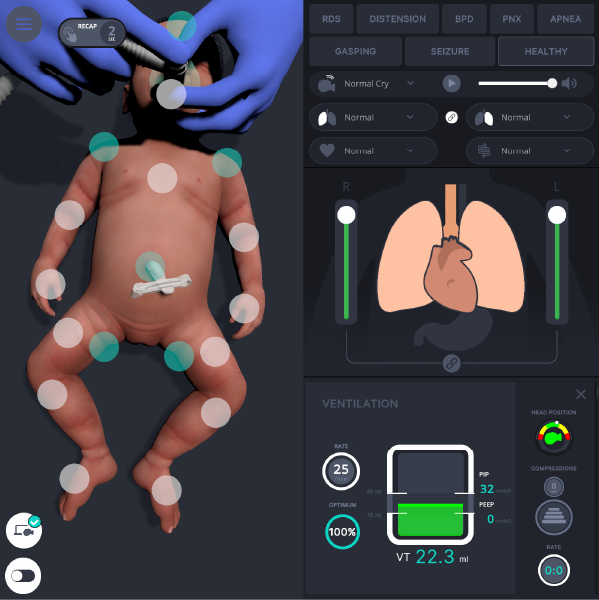
Peak pressure (PIP), PEEP and tidal volume (VT) are displayed here. This window can be shown or hidden as required.
Tidal volume is displayed both numerically (in mL) and visually using a color-coded bar. This makes it easy to assess whether ventilation is within the effective range.
Clicking the small plus (+) icon in the ventilation window reveals additional details, including peak inspiratory pressure (PIP), PEEP, ventilation rate and percentage of optimal ventilations.
NOTE
The optimum (green) range for the tidal volume is set to 4-8mL/kg and can be customized by users. For more information, refer to the Presets section.
Intubation
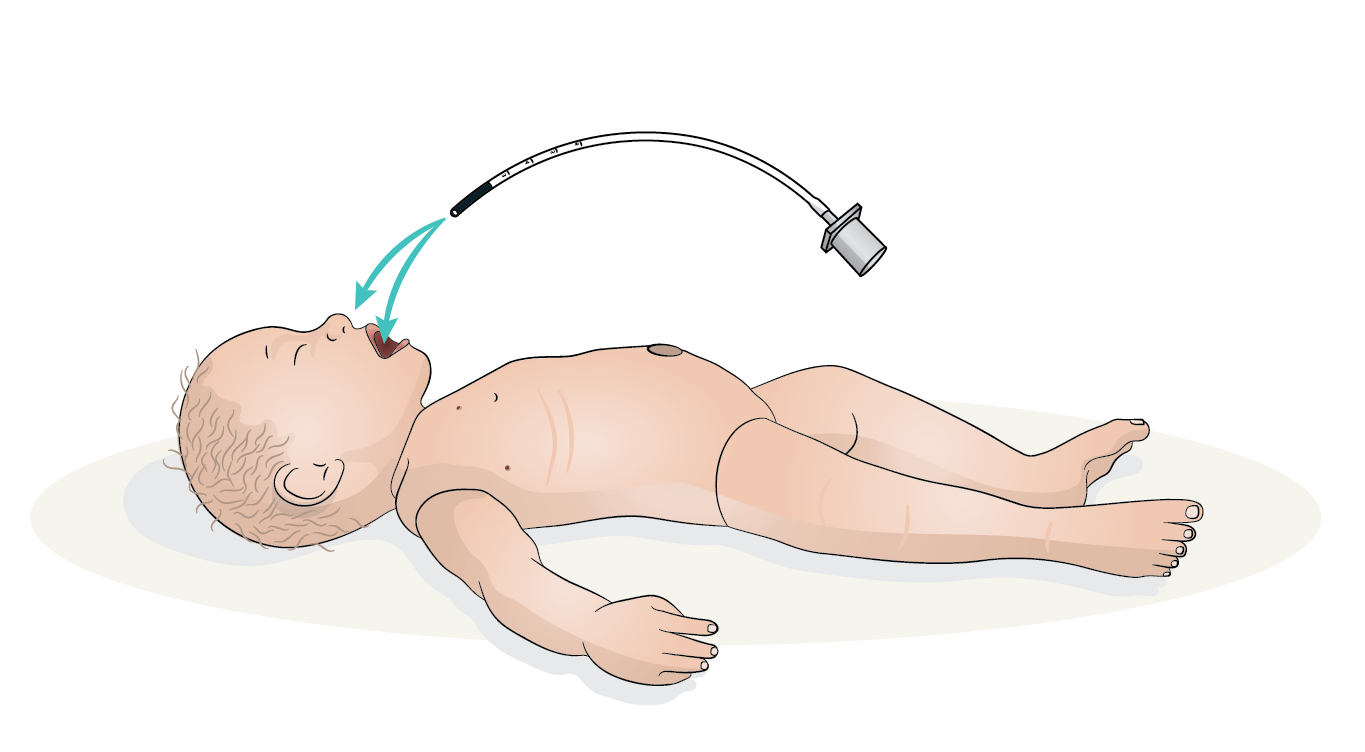
Emma/Emily can be intubated with an uncuffed endotracheal tube (max. size #3.5 ID).
NOTE
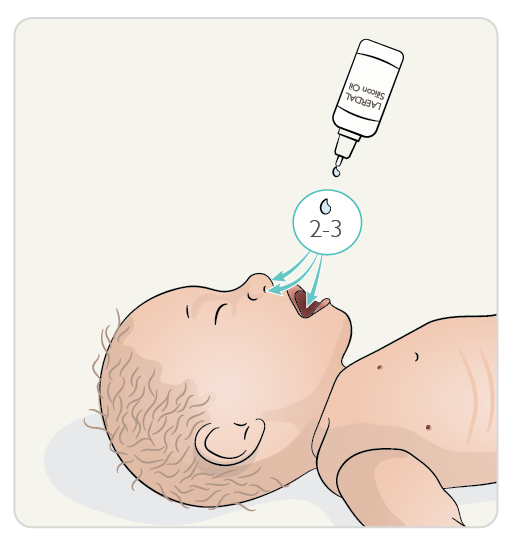
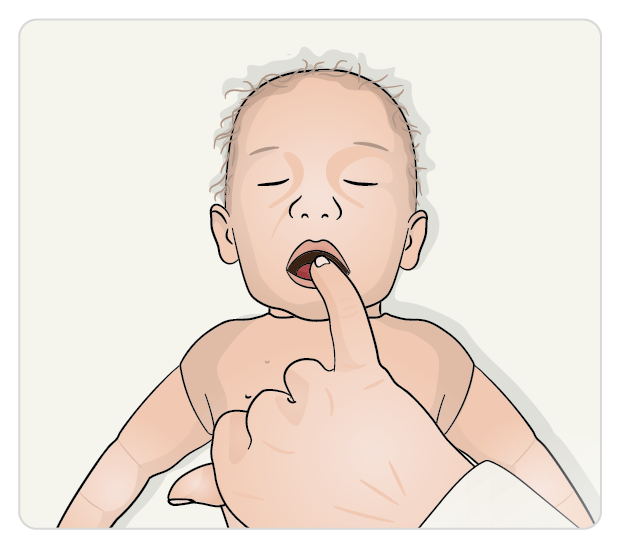
Before each training session, apply a few drops of silicone oil into the simulator's mouth. Use your pinky finger to gently spread the oil throughout the upper airway, ensuring all surfaces are evenly coated and no dry areas remain.
For longer sessions, repeat this procedure regularly to ensure smooth handling and protect the airway
During intubation, the tube appears on the Emma/Emily 3D animation and in the trachea of the animated lung. The tube depth is detected by the sensors and also displayed on the GUI.
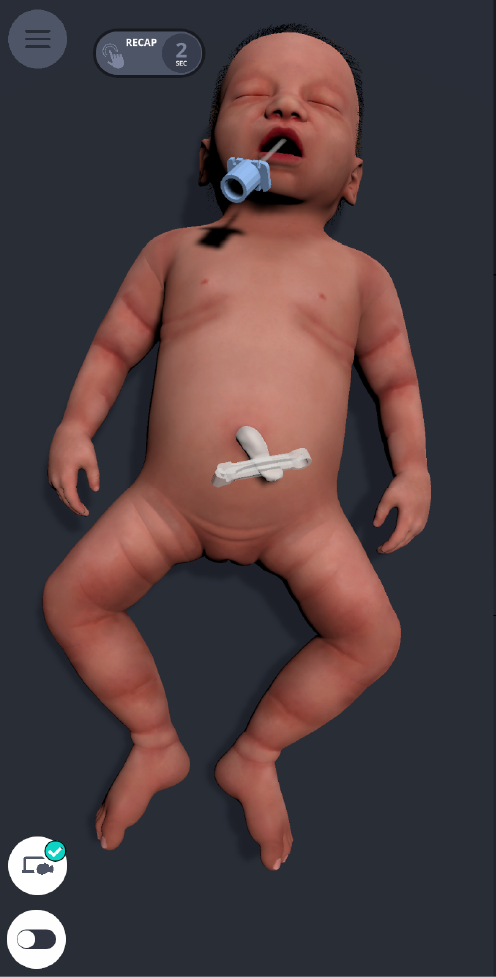
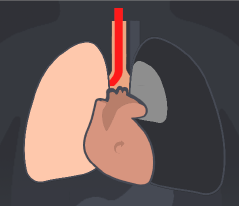
If the tube is pushed beyond the bifurcation of the trachea, it will enter the right main bronchus. As a result, the left lung collapses in the 3D animation and turns grey. If ventilation is then performed, only the chest on the right side rises, the left side of the chest no longer moves.
If the tube is pulled back right before the bifurcation, both sides of the chest rise again under ventilation.
If Emma/Emily is intubated into the esophagus, both the esophagus and stomach turn red in the lung animation area and only Emma/Emily‘s stomach rises under ventilation.
Emma/Emily can be intubated nasally or orally. This is not recognized by the simulator's sensors, but can be changed via the bubble in the area of the mouth and nose in the Emma/Emily 3D simulation, and in the system settings.
The default intubation display differs from regions:
For the European region, the display on the GUI is set by default for nasal intubation.
For the Anglo-American region, the display on the GUI is set by default for oral intubation.
CAUTION
Never administer drugs, fluids or surfactant into Emma/Emily‘s lungs and airway, as this can cause serious damage to the electronics.
TIP
Plaster strips for tube fixation, such as Steri-Strips®, do not adhere well to silicone simulators like Emma/Emily. We therefore recommend that you first apply a strip of silicone plaster (e.g. Mepitac®) to the areas of skin where the Steri-Strips® will ultimately be attached. The plaster strip can then be firmly attached to it.Both correct and incorrect intubations are displayed in the integrated debriefing system.